

5 Lessons Retirees Need to Know
November 2, 2026


In Short: After years of conversations with families preparing for or already living in retirement, five lessons come up again and again:
Imagine sitting down with thousands of people who've already retired and asking them what they wish they'd known before they left the workforce. What would they say they got right? What would they do differently? Over the years, we've had exactly those conversations, and a handful of lessons come up over and over.
Most retirees know healthcare will cost something. Few realize it can end up being the largest expense of their retirement, in part because Medicare doesn't cover everything. Premiums, deductibles, co-pays, prescriptions, dental, vision, and hearing all add up outside of what Medicare pays for, and there's also a coverage gap for anyone who retires before age 65 and isn't yet Medicare-eligible.
Fidelity's 2026 Retiree Health Care Cost Estimate found that a 65-year-old retiring this year can expect to spend an average of $185,500 on healthcare and medical expenses throughout retirement, up 7.5% from the year before. For a couple, that roughly doubles, and it still doesn't include the cost of long-term care. The lesson here is simple: don't wait until a major medical expense happens to figure out how you'll pay for healthcare.
A lot of retirees walk in knowing exactly how much they have in their 401(k) or IRA, but very little about what they'll actually owe in taxes on it. It's an understandable assumption. You're no longer earning a paycheck, so it seems reasonable that your tax bill would shrink too. In practice, IRA and 401(k) withdrawals are taxable, a portion of Social Security can become taxable, other investment income can be taxable, and eventually required minimum distributions force money out of these accounts whether you need it or not. All of that income lands in one bucket, and it adds up faster than most people expect.
This is where the difference between tax preparation and tax planning matters. Tax preparation is filling out the forms once the year is already over, whether that's done by a CPA, software, or a tax attorney. By that point, the year is history and there's little left to influence. Tax planning looks five, ten, even thirty years ahead, and a mistake in that planning can cost tens of thousands, sometimes hundreds of thousands, of dollars over a retirement. Within our own Blueprint process, taxes usually end up being the single biggest place we can help someone save.
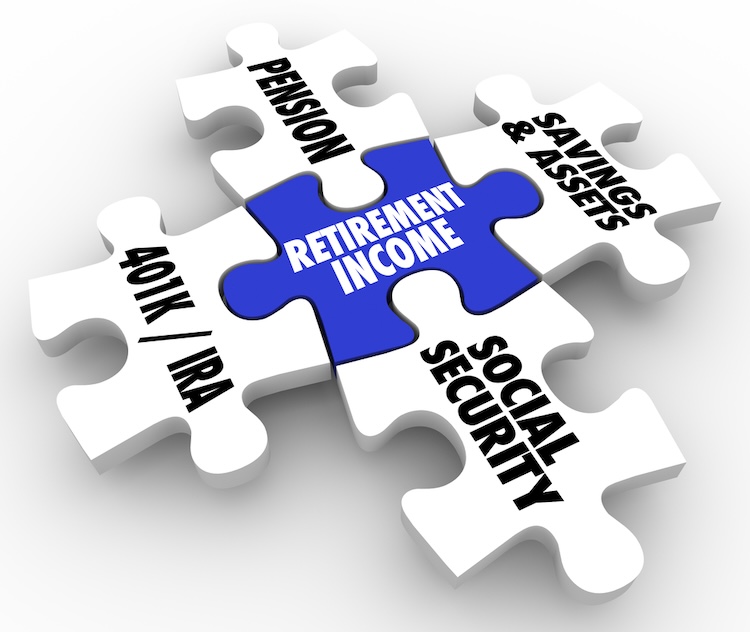
Before retirement, a paycheck arrives every two weeks without much thought required. After retirement, that paycheck stops, and savings has to take on a different role. It's no longer just a number to grow. It becomes the source of income that needs to hold up for 20 or 30 years, and that requires understanding where retirement income can actually come from.
Social Security is the foundation for most people, even for a spouse who didn't work outside the home, since spousal benefits are often available and frequently overlooked. Pensions have become rare outside of government employment. That leaves investments, and there are more sources within that bucket than people usually consider: dividends from established companies, interest from savings or CDs (a strategy that worked well when CD rates were near 18% in the 1980s but far less reliably since), rental real estate, which comes with more expenses than the "mailbox money" reputation suggests, and annuities, which function as a private pension by converting an IRA or 401(k) into a guaranteed income stream from an insurer that's been paying claims for over a century. The goal isn't simply accumulating a large balance. It's turning that balance into an income workhorse you can actually live on.
Filing for Social Security is more complicated than following a neighbor's advice or picking an age because it feels safe. Some people file at 62 out of uncertainty about how long they'll live. Others wait until 70 for the largest possible check. Neither approach accounts for spousal benefits, how the timing interacts with pension or investment income, or how that income might push you into a higher tax bracket. There isn't one right age for everyone. It's a decision worth working through with someone who can walk through the specific scenarios that apply to your situation.
At 30 or 40, a market decline is uncomfortable but recoverable, since there's time on your side. Near or in retirement, the math changes. This is often described as sequence of returns risk: if the market drops shortly after you retire and you're withdrawing money at the same time, the portfolio may never fully recover, even if the long-term average return ends up being the same. The opposite is also true, and a market that climbs early in retirement makes running out of money far less likely. Since nobody can control which scenario they'll get, the more useful move is rebalancing risk as you approach retirement rather than hoping the timing works out, and reviewing that risk from both spouses' perspectives, since risk tolerance often differs between partners.
Prepare for healthcare costs before they arrive. Don't assume taxes will simply go down. Build a real strategy for turning savings into income. Think carefully before filing for Social Security. And understand how much risk you're actually taking as retirement gets closer. Millions of people have already gone through this transition, and learning from what they wish they'd known can make the decisions ahead of you a little clearer. We've helped more than 55,000 families work through exactly this kind of planning, and we'd love to help you too. Request your free B.O.S.S. Retirement Blueprint to see where your own plan stands.
About the Author
Tyson Thacker is co-founder of B.O.S.S. Retirement Advisors and Solutions, where he helps pre-retirees and retirees build tax-efficient, income-focused retirement plans. Learn more about Tyson.
This article is for educational purposes only and does not constitute personalized financial, tax, or legal advice. Social Security rules and tax laws are subject to change. Individual results will vary based on personal circumstances. Consult a qualified financial professional before making any financial decisions. Advisory services offered through B.O.S.S. Retirement Advisors, LLC, an SEC-Registered Investment Advisor. Insurance products and services offered through B.O.S.S. Retirement Solutions. Our firm is not affiliated with the Social Security Administration, U.S. government, or any governmental agency.
Related Resources
The Framework for a More Confident Retirement
Designed to deliver simplified, personalized financial strategies, The B.O.S.S. Retirement Blueprint™ planning process helps maximize income, growth and legacy while minimizing taxes. Ready to view your retirement from a new angle?